

2026 Honda Passport vs Mazda CX-70
2026 Honda Passport vs Mazda CX-70
When shopping for a midsize SUV that balances family practicality with weekend adventure capability, two standout options emerge: the completely redesigned 2026 Honda Passport and the stylish 2025 Mazda CX-70 in Phoenix. Both vehicles target families who want more space than a compact crossover but don't necessarily need a third row of seating.
However, these SUVs take distinctly different approaches to winning over buyers. The Honda Passport embraces a "Born Wild" philosophy with genuine off-road capability and maximum cargo space, while the Mazda CX-70 in Phoenix focuses on road manners and styling. This comprehensive comparison examines cargo space, drivetrain technology, off-road capability, safety features, and long-term value to help you determine which midsize SUV best fits your lifestyle.
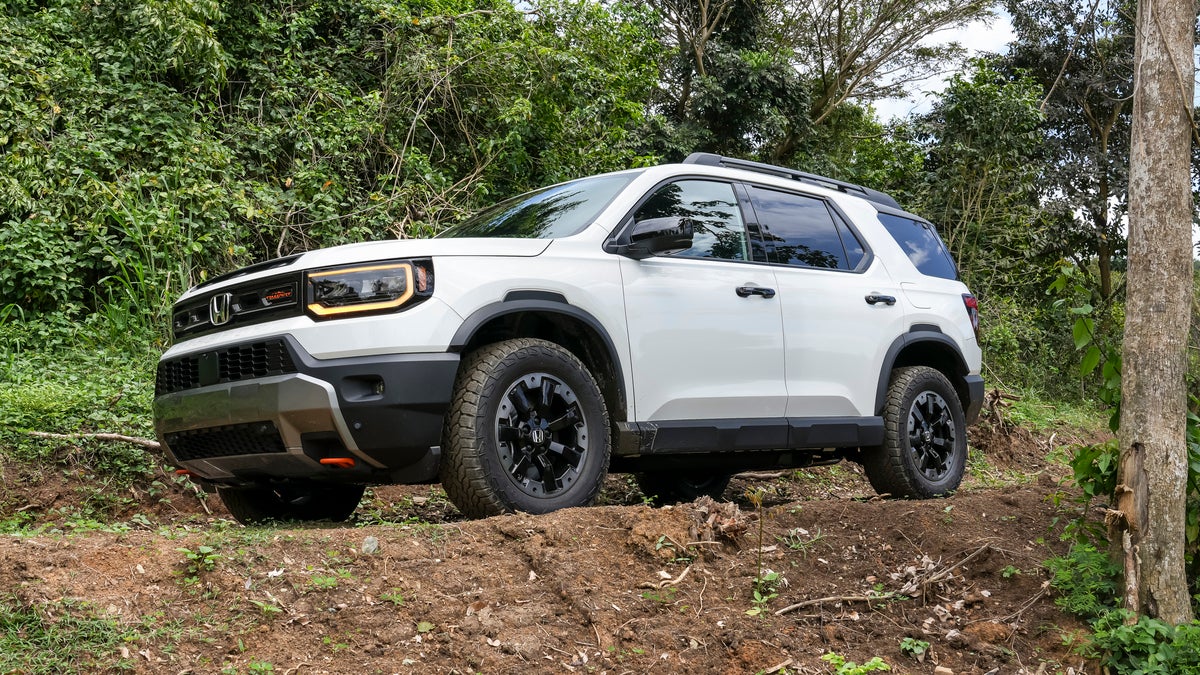
Midsize SUV Overview: Honda vs Mazda Philosophy
The fundamental difference between these SUVs starts with their design philosophy. Honda developed the 2026 Passport around adventure readiness, creating what reviewers call "the 4Runner for normal people." The boxy, rugged styling isn't just for show – it's backed by legitimate off-road hardware and the most capable all-wheel-drive system Honda has ever offered.
Mazda took a different route with the CX-70 in Phoenix, emphasizing premium materials, sporty handling, and sophisticated design. However, this approach has drawn criticism from automotive journalists who question why the CX-70 exists when the nearly identical three-row CX-90 offers more versatility at a similar price. The consensus among professional reviewers suggests the Passport has clearer purpose and market positioning, making it easier for buyers to understand what they're getting.
Performance & Drivetrain: Which SUV Has Better All-Wheel Drive?
Under the hood, both SUVs offer compelling but different powertrains. The Honda Passport features a naturally aspirated 3.5-liter V6 producing 285 horsepower and 262 lb-ft of torque, paired with a new 10-speed automatic transmission. Professional reviewers praise the engine's "hushed operation" that builds into an "effervescent zing" when accelerating, noting it sounds much better than turbocharged four-cylinder competitors.
The Mazda CX-70 in Phoenix offers more power options, including a 280-horsepower base turbo and a more expensive 340-horsepower Turbo S variant, both using a 3.3-liter turbocharged inline-six. Long-term testing has revealed Mazda transmission issues including shuddering, hesitation, and abrupt shifts that disrupt the driving experience.
Where Honda truly excels is in all-wheel-drive technology. The Passport's second-generation i-VTM4 system features a torque-vectoring rear differential with 40% more torque capacity and 30% faster response than the previous generation. This advanced system actively distributes power to individual wheels for maximum traction, whether you're navigating snowy roads or rocky trails. The reliable midsize SUV segment has long favored Honda's naturally aspirated engines and proven all-wheel drive systems for their long-term dependability. 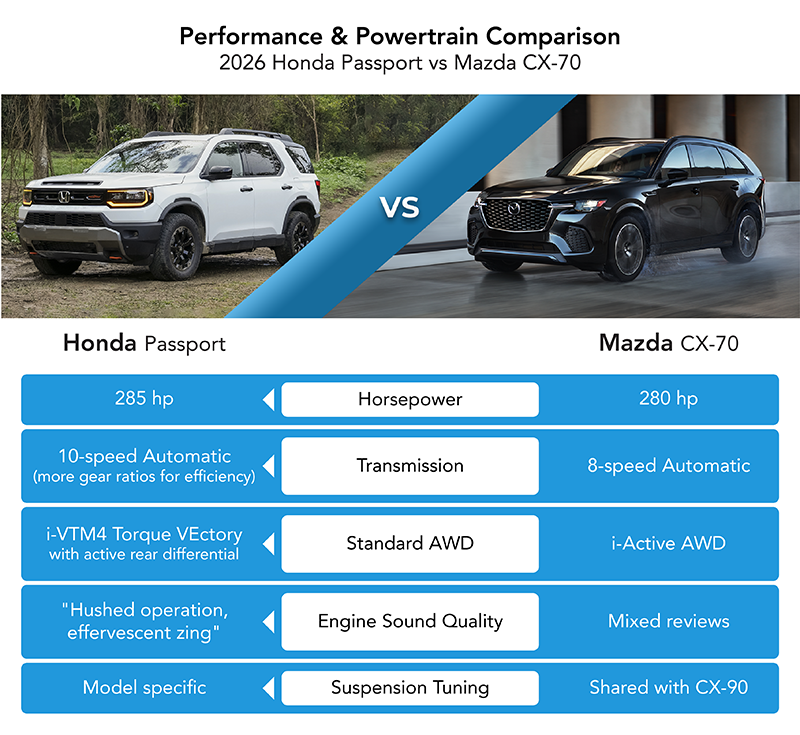
Cargo Space Comparison: Which Midsize SUV Has More Room?
When it comes to hauling gear for family adventures, the Honda Passport significantly outperforms the Mazda CX-70 in Phoenix. The Passport offers 83.8 cubic feet of cargo space with the rear seats folded, compared to the CX-70's 75.3 cubic feet – a substantial 8.5 cubic foot advantage. Even with the rear seats up, the Passport provides 44.0 cubic feet versus the CX-70's 39.6 cubic feet.
This SUV cargo space comparison becomes even more meaningful when you consider Honda's approach to storage organization. Reviewers note that "every corner of the (Passport) cabin seems to have been mined for storage", while CX-70 owners specifically mention limited storage space as a common complaint. For Phoenix area families who frequently travel to outdoor destinations or need space for sports equipment, the Honda’s cargo advantage proves significant in daily use.
Both vehicles offer 5,000-pound towing capacity (though the CX-70 PHEV is limited to 3,500 pounds), making them capable family SUVs for boat or trailer hauling. However, the Passport's superior cargo space makes it more practical for camping gear, sports equipment, or large shopping trips that active families require. 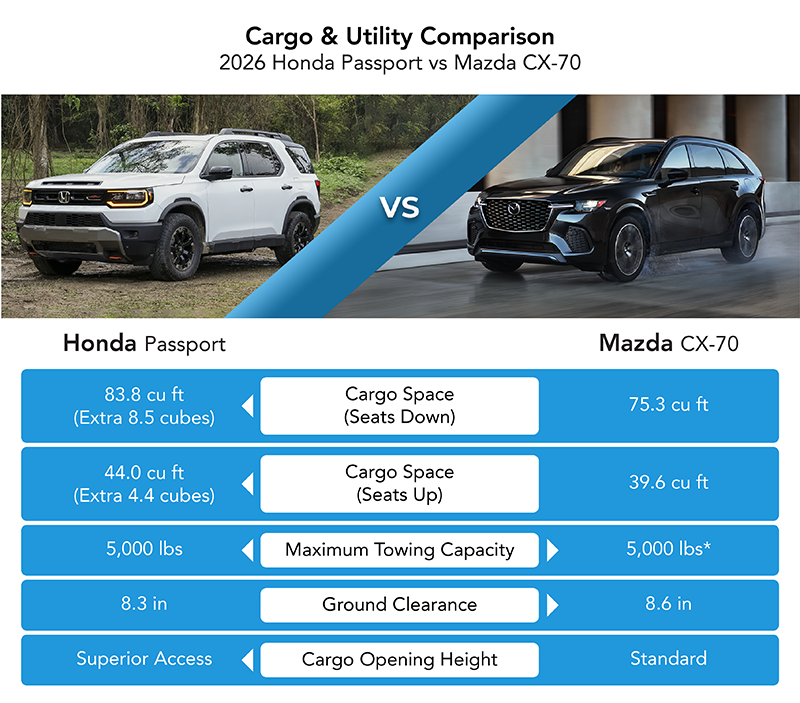
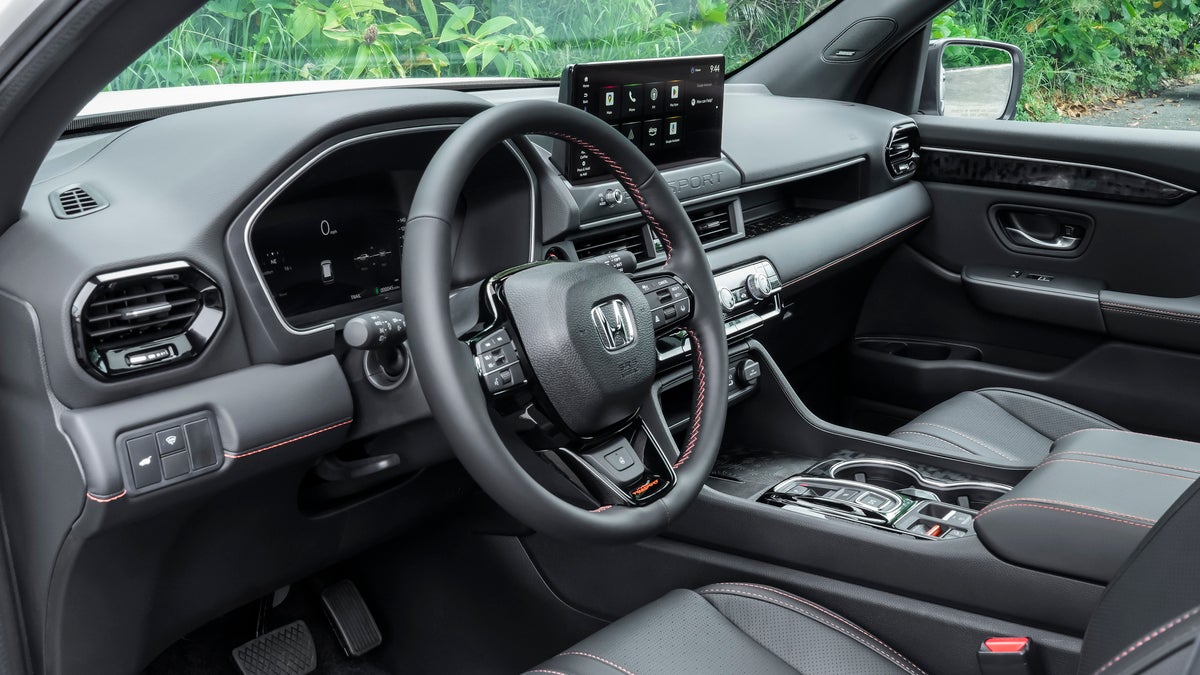
Off-Road Capability: Adventure-Ready vs Road-Focused
The most significant difference between these midsize SUVs lies in their off-road capability. Honda offers dedicated TrailSport and TrailSport Elite variants that transform the Passport into what Car and Driver calls "Adventure-Ready Out of the Box". These models feature a specially-tuned suspension, all-terrain tires, and full underbody skid plates. Its heavy-duty recovery points are rated to support twice the vehicle's weight.
Professional testing revealed the Passport TrailSport churns through loose surfaces with confidence, a capability that separates it from typical crossovers. The system includes seven drive modes, including dedicated Trail and Tow settings that optimize traction for specific conditions.
The Mazda CX-70 in Phoenix, conversely, offers no off-road-focused variants. While it features standard all-wheel drive and multiple drive modes, it's designed primarily for on-road experiences. For families considering weekend trips to Arizona's diverse terrain, Phoenix Mazda dealers must acknowledge that the CX-70 lacks the specialized equipment that makes the Passport TrailSport genuinely trail-capable. This makes the best midsize SUV choice clear for buyers who want genuine adventure capability beyond paved roads. 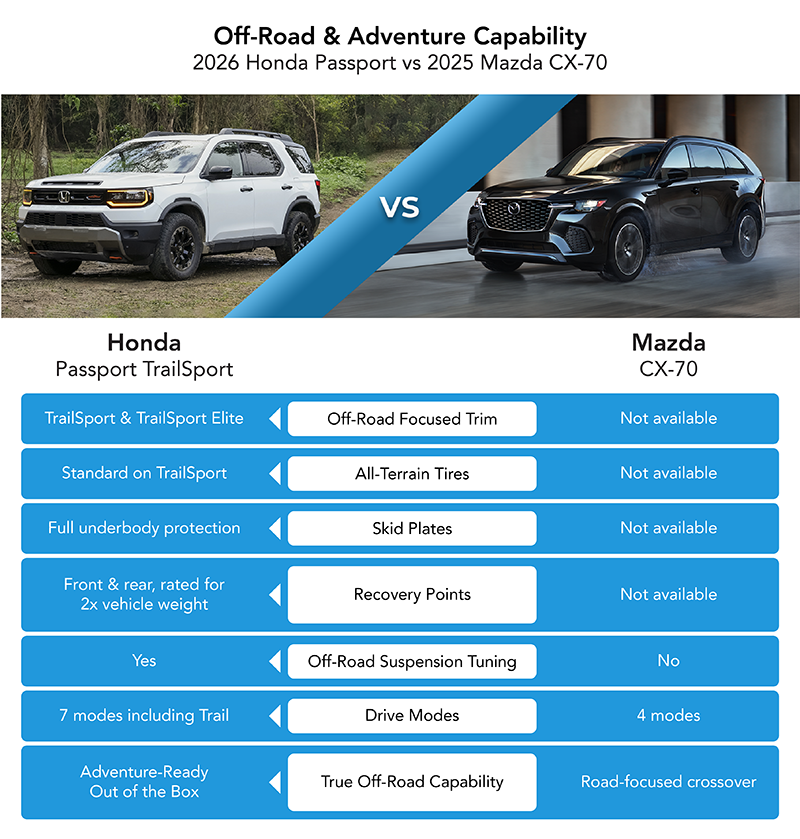
Safety & Technology: Top Safety Pick Comparison
Both SUVs prioritize safety, but Honda takes a more comprehensive approach. The 2026 Passport targets the Insurance Institute for Highway Safety's Top Safety Pick+ rating and is designed to meet the new Side Impact Crashworthiness Evaluation 2.0 standards. It features eight standard airbags, including Honda's award-winning three-chamber front passenger airbag.
The Mazda CX-70 earned IIHS Top Safety Pick status (one level below the Passport's target), with six standard airbags and Mazda's i-Activsense safety suite. Both vehicles offer 12.3-inch infotainment screens with wireless Apple CarPlay and Android Auto, making this SUV safety comparison relatively close in technology features.
Honda's updated Sensing suite benefits from a wider 90-degree camera view and enhanced radar coverage, providing more comprehensive collision prevention than the previous generation. This positions the Passport as a leader in the SUV safety comparison within the midsize segment. 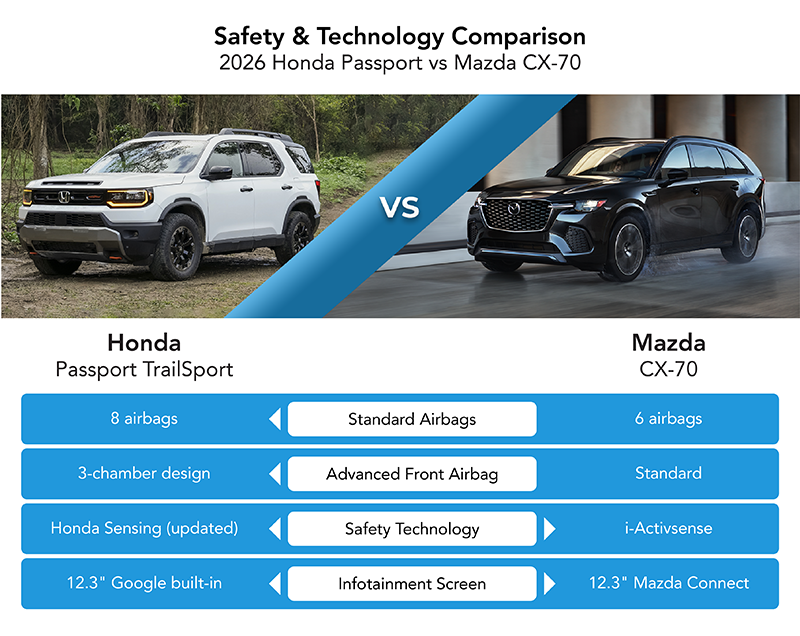

Value & Long-Term Ownership: Honda vs Mazda Reliability
Pricing favors the Mazda initially, with the CX-70 starting around $40,445 compared to the Passport's mid-$40,000s starting price. However, the Honda vs Mazda reliability comparison favors Honda's proven track record. Honda's naturally aspirated V6 and established all-wheel-drive systems have decades of reliability data supporting their durability.
Automotive experts consistently rate the Passport as "one of the best midsize SUVs on sale today" for buyers who don't need a third row, while professional reviews of the CX-70 question its market positioning against Mazda's own three-row alternative. Honda's resale values and reliability reputation provide advantages that offset the initial price difference at Mazda dealers in Phoenix.
Honda's extensive dealer network and strong resale values also support long-term ownership costs, making the initial price premium worthwhile for many buyers. The most reliable midsize SUV segment historically favors vehicles with clear purpose and proven powertrains, both areas where the Passport excels.
Which Midsize SUV Should You Choose?
For most buyers seeking the best midsize SUV for families, the Honda Passport's combination of space, capability, and reliability makes it the more compelling choice in this competitive segment.
Get some hands-on research into midsize SUVs at Earnhardt Honda. Schedule a test drive.

Price(s) plus government fees such as Tax, Title & License. On all vehicles, actual vehicle sale price and payments may vary for various reasons - including but not limited to - applicable manufacturer offers, special limited time offers, government taxes, licensing fees, buyer's credit qualifications, dealer installed accessories or market product (or vehicle) availability. Financing on approved credit. Must qualify for some offers. Some offers may not be available with special financing, lease and certain other offers.
Although every reasonable effort has been made to ensure the accuracy of the information contained on our website, absolute accuracy cannot be guaranteed. Dealer cannot be held liable for data that may be listed incorrectly. While we make every effort to ensure the data listed here is correct, there may be instances where some of the factory offers or rates, options or vehicle features may be listed incorrectly as we receive data from multiple data sources. All vehicles are subject to prior sale. Not responsible for typographical errors. Equipment added by the dealer or the purchaser will increase the overall transaction amount
Any MPG listed is based on model year EPA mileage ratings. Use for comparison purposes only. Your actual mileage will vary, depending on how you drive and maintain your vehicle, driving conditions, battery pack age/condition (hybrid only) and other factors. For additional information about EPA ratings, visit https://fueleconomy.gov/feg/label/learn-more-phev-label.shtml
Refer to our Privacy and User Consentfor details about information we collect and various communication methods we will use to assist customers. By providing your contact information to ANY form contained in – or connected to – this website, you are hereby agreeing to receive text messages from this dealership and our affiliates or partners at the number(s) and/or information which you have provided. You are also expressly consenting to recurring contact from the aforementioned company or its business partners at the number you provided regarding products or services via live, automated or prerecorded telephone call, text message or email. You understand that your telephone provider may impose charges on you for these contacts, and you are not required to enter into this agreement/consent as a condition of purchasing property, goods, or services. You also understand that you may revoke this consent at any time by notifying the dealership in writing.